A professional home for independent minds.
The National Association of Independent Educators is a nonpartisan resource for educators who value freedom of association, self-determination, and a professional life free from partisan pressure.
We put educators’ needs and judgment at the center. You deserve useful resources, trusted connections, and the freedom to choose the organizations and support that fit your values.
Through Community, Career, and Counsel, NAIE helps independent-minded educators connect, grow, and make informed decisions—with respect for differing viewpoints and a shared commitment to students and academic excellence.

Why NAIE is different.
Professional support should leave room for independent thought. Educators deserve a community where belonging does not depend on adopting a party’s platform or an organization’s political agenda. NAIE welcomes different viewpoints and keeps its focus on the needs of educators, students, and local communities.
Respect builds trust. Partisan rhetoric erodes it.
Principles matter. Intellectual honesty, freedom of inquiry, and respect for differing views are essential to education. Partisanship is toxic to an academic environment when loyalty to a political side takes precedence over evidence, open discussion, and independent judgment.
NAIE supports educators who stand by their principles while engaging others with curiosity and respect. We build trust through professional support that encourages thoughtful disagreement and keeps students and learning at the center.
See educators as individuals.
Educators bring a range of political views to their work. The EdWeek Research Center’s 2025 report, Partisan Polarization & K-12 Education, surveyed 559 teachers and school and district leaders. Figure 1 shows that 63% reported voting for Kamala Harris in 2024, 24% for Donald Trump, 5% for a third-party candidate, and 8% did not vote. Yet the report also found shared priorities across partisan lines, including helping students understand government and their rights. A vote reveals one choice; it does not define an educator’s views on every issue.
An earlier Education Week survey (2017), reported by Alyson Klein, illustrates the spread of political outlooks more directly. Among 1,122 educators, 43% identified as moderate, compared with roughly 30% as liberal or very liberal and 27% as conservative or very conservative. The left and right represented similar shares, while the largest group placed itself in the middle. That moderate group was a plurality, rather than a majority. These findings describe the 2017 respondents; they should not be treated as today’s ideological breakdown or equated with the 2025 voting figures.
The Heritage Foundation’s 2021 study, Political Opinions of K–12 Teachers: Results from a Nationally Representative Survey, by Jay Greene and James Paul, adds an issue-based perspective. Drawing on an Ipsos survey that included 611 active K–12 teachers, the authors found that teachers’ average responses on the issues studied were generally moderate or somewhat left of center, and closer to the average respondent’s views than to either ideological pole.
Teachers are individuals, not a single political constituency. NAIE welcomes that diversity of thought. We bring educators together around professional needs, freedom of association, and a shared commitment to students—without making political agreement a condition of belonging.
Freedom of association. Self-determination. Practical support.
Freedom of association: We respect educators’ ability to choose the professional relationships and organizations that align with their needs and convictions.
Self-determination: We help educators evaluate options and make their own informed decisions. Their judgment and local priorities guide the path forward.
Nonpartisan purpose: We bring people together around professional needs and academic excellence. Political agreement is not a condition of belonging.
Three pillars, one professional home.
Community creates opportunities for collegial connection, local relationships, and shared learning.
Career connects educators with professional growth, career pathways, and classroom resources.
Counsel helps educators explore professional protection and access appropriate legal resources and referrals.
You bring your experience, your questions, and your independent judgment. NAIE helps you find the resources and community to move forward.
Why NAIE is different.
Professional support should leave room for independent thought. Educators deserve a community where belonging does not depend on adopting a party’s platform or an organization’s political agenda. NAIE welcomes different viewpoints and keeps its focus on the needs of educators, students, and local communities.
Respect builds trust. Partisan rhetoric erodes it.
Principles matter. Intellectual honesty, freedom of inquiry, and respect for differing views are essential to education. Partisanship is toxic to an academic environment when loyalty to a political side takes precedence over evidence, open discussion, and independent judgment.
NAIE supports educators who stand by their principles while engaging others with curiosity and respect. We build trust through professional support that encourages thoughtful disagreement and keeps students and learning at the center.
See educators as individuals.
Educators bring a range of political views to their work. The EdWeek Research Center’s 2025 report, Partisan Polarization & K-12 Education, surveyed 559 teachers and school and district leaders. Figure 1 shows that 63% reported voting for Kamala Harris in 2024, 24% for Donald Trump, 5% for a third-party candidate, and 8% did not vote. Yet the report also found shared priorities across partisan lines, including helping students understand government and their rights. A vote reveals one choice; it does not define an educator’s views on every issue.
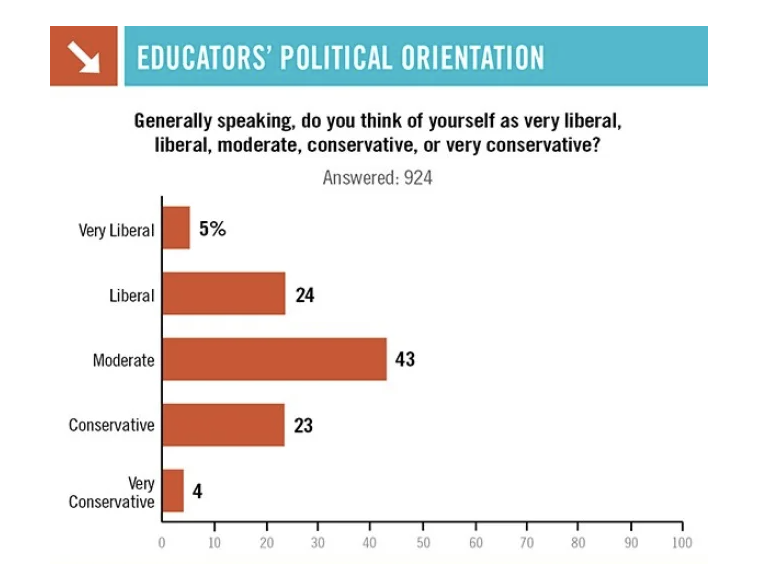
An earlier Education Week survey (2017), reported by Alyson Klein, illustrates the spread of political outlooks more directly. The survey included 1,122 educators; 924 answered the political-orientation question. Of those respondents, 43% identified as moderate, compared with 29% as liberal or very liberal and 27% as conservative or very conservative. The left and right represented similar shares, while the largest group placed itself in the middle. That moderate group was a plurality, rather than a majority. These findings describe the 2017 respondents; they should not be treated as today’s ideological breakdown or equated with the 2025 voting figures.
The Heritage Foundation’s 2021 study, Political Opinions of K–12 Teachers: Results from a Nationally Representative Survey, by Jay Greene and James Paul, adds an issue-based perspective. Drawing on an Ipsos survey that included 611 active K–12 teachers, the authors found that teachers’ average responses on the issues studied were generally moderate or somewhat left of center, and closer to the average respondent’s views than to either ideological pole.
Teachers are individuals, not a single political constituency. NAIE welcomes that diversity of thought. We bring educators together around professional needs, freedom of association, and a shared commitment to students—without making political agreement a condition of belonging.
Freedom of association. Self-determination. Practical support.
Freedom of association: We respect educators’ ability to choose the professional relationships and organizations that align with their needs and convictions.
Self-determination: We help educators evaluate options and make their own informed decisions. Their judgment and local priorities guide the path forward.
Nonpartisan purpose: We bring people together around professional needs and academic excellence. Political agreement is not a condition of belonging.
Three pillars, one professional home.
Community creates opportunities for collegial connection, local relationships, and shared learning.
Career connects educators with professional growth, career pathways, and classroom resources.
Counsel helps educators explore professional protection and access appropriate legal resources and referrals.
You bring your experience, your questions, and your independent judgment. NAIE helps you find the resources and community to move forward.
Our founder
Keith J. Williams · Founder & CEO
Keith’s rationale for creating NAIE begins with his 21 years as a public high school teacher and coach. From a classroom teacher’s perspective, professional support should help educators serve their students, grow in their work, and navigate challenges while respecting their independent judgment.
That perspective shaped the need NAIE exists to meet—a professional home where educators can find community, useful resources, and trusted support without being expected to adopt a political platform. A teacher should not have to choose between professional security and personal convictions—or feel that disagreement means facing the profession alone.
His subsequent national work in educator organizing and labor reform strengthened his commitment to freedom of association and self-determination. Educators deserve clear information, meaningful options, and the ability to decide which relationships and resources fit their needs.
Keith founded NAIE to bring that vision together through Community, Career, and Counsel. The approach is grounded in the classroom: listen to educators, earn trust, and keep students and learning at the center.